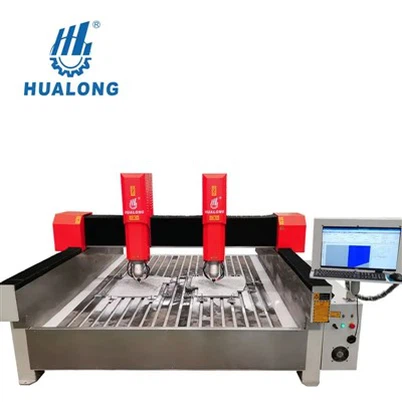

How does a 5 Axis Bridge Saw ensure the straightness of the cut?
Leave a message

In the realm of stone processing, achieving the utmost precision in cutting is of paramount importance. One of the most advanced tools in this field is the 5 Axis Bridge Saw. As a trusted supplier of 5 Axis Bridge Saws, I've witnessed firsthand the transformative impact these machines have on the industry. In this blog, I'll delve into how a 5 Axis Bridge Saw ensures the straightness of the cut, highlighting the key features and technologies that make it a game - changer.
Understanding the Basics of a 5 Axis Bridge Saw
Before we explore how it ensures straight cuts, let's understand what a 5 Axis Bridge Saw is. A 5 Axis Bridge Saw is a highly sophisticated piece of equipment designed to cut stone materials such as granite, marble, and quartz with exceptional precision. Unlike traditional saws that operate in a limited number of axes, a 5 Axis Bridge Saw can move along five different axes simultaneously. This multi - axis movement allows for complex cutting operations, including bevel cuts, angled cuts, and curved cuts, while still maintaining the straightness of the cut.
Precision Engineering for Straight Cuts
The first and most fundamental aspect that ensures the straightness of the cut is the machine's precision engineering. Our 5 Axis Bridge Saws are built with high - quality materials, such as heavy - duty steel frames. These frames provide a stable base for the saw's operation, minimizing vibrations that could otherwise lead to uneven cuts. The use of precision linear guides and ball screws further enhances the accuracy of the machine's movement. These components are designed to move smoothly and precisely along the axes, ensuring that the saw blade follows the intended cutting path with minimal deviation.
Advanced Control Systems
Another crucial factor in ensuring straight cuts is the advanced control system of the 5 Axis Bridge Saw. Our machines are equipped with state - of the - art CNC (Computer Numerical Control) systems. These systems allow operators to input precise cutting parameters, such as the length, width, and angle of the cut. The CNC system then controls the movement of the saw blade along the five axes, ensuring that it follows the programmed path exactly. This level of automation eliminates the potential for human error, which is a common cause of uneven cuts in manual cutting processes.
Real - Time Monitoring and Adjustment
To further enhance the straightness of the cut, our 5 Axis Bridge Saws are equipped with real - time monitoring systems. These systems continuously monitor the position and movement of the saw blade during the cutting process. If any deviation from the programmed path is detected, the system can make immediate adjustments to correct the blade's position. This real - time feedback loop ensures that the cut remains straight and accurate throughout the entire cutting operation.
Blade Technology
The type of blade used in a 5 Axis Bridge Saw also plays a significant role in ensuring straight cuts. We use high - quality diamond blades that are specifically designed for stone cutting. These blades are engineered to have a sharp and consistent cutting edge, which helps to minimize chipping and ensure a smooth, straight cut. Additionally, the blade's diameter and thickness are carefully selected based on the type of stone being cut and the desired cutting depth. This optimization of blade parameters further contributes to the straightness and quality of the cut.
Calibration and Maintenance
Regular calibration and maintenance are essential for ensuring the long - term straightness of cuts made by a 5 Axis Bridge Saw. Our machines are designed to be easily calibrated, allowing operators to adjust the alignment of the axes and the blade's position. This calibration process ensures that the machine is operating at its optimal level of accuracy. Additionally, routine maintenance, such as blade sharpening and lubrication of moving parts, helps to keep the machine in top condition and ensures consistent straight cuts over time.
Applications and Benefits
The ability of a 5 Axis Bridge Saw to ensure straight cuts has numerous applications in the stone processing industry. For example, in the production of countertops, a straight cut is essential for a perfect fit and a professional finish. Our 5 Axis Bridge Saws can cut granite and marble countertops with precision, ensuring that they fit seamlessly into any kitchen or bathroom. In the construction of architectural elements, such as columns and facades, straight cuts are crucial for maintaining the structural integrity and aesthetic appeal of the final product.
The benefits of using a 5 Axis Bridge Saw for straight cuts extend beyond precision. These machines also offer increased productivity compared to traditional cutting methods. The ability to perform complex cuts in a single operation reduces the need for multiple passes and manual adjustments, saving time and labor costs. Additionally, the high - quality cuts produced by our 5 Axis Bridge Saws result in less waste, making them a more sustainable choice for stone processing.


Related Products
If you're interested in exploring more about stone cutting machines, you can check out our Automatic Granite Cutting Machine, CNC Bridge Saw Machine, and Marble Cutting Machines Italy. These products offer similar levels of precision and performance, catering to different needs in the stone processing industry.
Contact for Purchase and Consultation
If you're in the market for a 5 Axis Bridge Saw or have any questions about our products, we're here to help. Our team of experts can provide you with detailed information about our machines, including specifications, pricing, and after - sales support. We're committed to helping you find the right solution for your stone processing needs. Whether you're a small - scale fabricator or a large - scale manufacturer, our 5 Axis Bridge Saws can provide the precision and reliability you need. Reach out to us to start a conversation about your requirements and how our products can benefit your business.
References
- Stone Processing Handbook, Third Edition. A comprehensive guide on stone cutting technologies and equipment.
- Journal of Precision Engineering. Articles on the latest advancements in CNC machining and cutting precision.
- Industry reports on the stone processing industry, highlighting the importance of precision cutting in modern manufacturing.