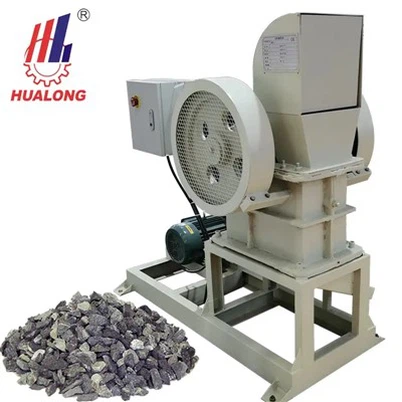

What is the power consumption of a stone crushing machine?
Leave a message

What is the power consumption of a stone crushing machine?
As a supplier of stone crushing machines, I often receive inquiries from customers about the power consumption of these machines. Understanding the power consumption of a stone crushing machine is crucial for both operational efficiency and cost - effectiveness. In this blog, I will delve into the factors that influence the power consumption of stone crushing machines and provide some insights on how to optimize it.
Factors Affecting Power Consumption
-
Machine Type
There are various types of stone crushing machines available in the market, each with different power requirements. For example, a Jaw Crusher Machine is a primary crusher that uses compressive force to break large stones into smaller pieces. It typically has a relatively high power consumption due to the heavy - duty nature of its operation. On the other hand, some secondary crushers, like cone crushers, may consume less power as they are designed to further process the pre - crushed materials. -
Material Characteristics
The properties of the stones being crushed play a significant role in determining power consumption. Harder stones, such as granite or basalt, require more energy to break compared to softer stones like limestone. The moisture content of the material also affects power consumption. Wet materials can cause clogging in the crusher, increasing the load on the machine and thus consuming more power. -
Crushing Ratio
The crushing ratio is defined as the ratio of the input size of the material to the output size. A higher crushing ratio means that the machine has to break the stones into much smaller pieces, which generally requires more power. For instance, if you want to crush large boulders into fine sand, the power consumption will be significantly higher compared to a lower crushing ratio operation. -
Machine Capacity
The production capacity of a stone crushing machine is another important factor. Larger capacity machines are designed to process more material per unit time, and they usually require more power to operate. However, in some cases, larger machines can be more energy - efficient on a per - ton basis as they can take advantage of economies of scale.
Calculating Power Consumption
The power consumption of a stone crushing machine can be estimated using the following general formula:
[P = K\times Q\times E]


Where:
- (P) is the power consumption (in kilowatts, kW)
- (Q) is the production capacity of the machine (in tons per hour, t/h)
- (E) is the specific energy consumption (in kWh/t), which depends on the machine type, material characteristics, and crushing ratio
- (K) is a coefficient that takes into account the efficiency of the motor and other factors
The specific energy consumption (E) can vary widely depending on the factors mentioned above. For example, for a jaw crusher crushing hard granite, the specific energy consumption may be around 3 - 5 kWh/t, while for a cone crusher processing limestone, it may be around 1 - 3 kWh/t.
Optimizing Power Consumption
-
Proper Machine Selection
Choosing the right type and size of the stone crushing machine according to your production requirements is essential. If you have a small - scale operation, a smaller capacity machine may be sufficient, which will consume less power. On the other hand, for large - scale production, a high - capacity machine may be more energy - efficient in the long run. -
Regular Maintenance
Regular maintenance of the stone crushing machine can ensure its optimal performance and reduce power consumption. This includes checking and tightening loose parts, lubricating moving components, and replacing worn - out parts. A well - maintained machine will operate more smoothly and require less power to achieve the same production output. -
Material Preparation
Pre - screening the stones before feeding them into the crusher can remove fine particles and reduce the load on the machine. This can significantly reduce power consumption, especially when dealing with materials that contain a large amount of fines. Additionally, drying wet materials can prevent clogging and improve the efficiency of the crushing process. -
Automation and Control Systems
Implementing advanced automation and control systems can optimize the operation of the stone crushing machine. These systems can adjust the feed rate, crushing speed, and other parameters based on the real - time conditions, ensuring that the machine operates at its most energy - efficient point.
Conclusion
The power consumption of a stone crushing machine is influenced by multiple factors, including machine type, material characteristics, crushing ratio, and machine capacity. By understanding these factors and taking appropriate measures to optimize power consumption, such as proper machine selection, regular maintenance, material preparation, and the use of automation systems, operators can reduce energy costs and improve the overall efficiency of their stone crushing operations.
If you are in the market for a high - quality Crusher Machine Stone Crushing or Rock Crusher Stone Crushing Machine, and want to learn more about power consumption and other technical details, please feel free to contact us. We are here to provide you with professional advice and solutions tailored to your specific needs.
References
- "Crushing and Screening Handbook", published by the mining industry association.
- Technical manuals of various stone crushing machine manufacturers.